
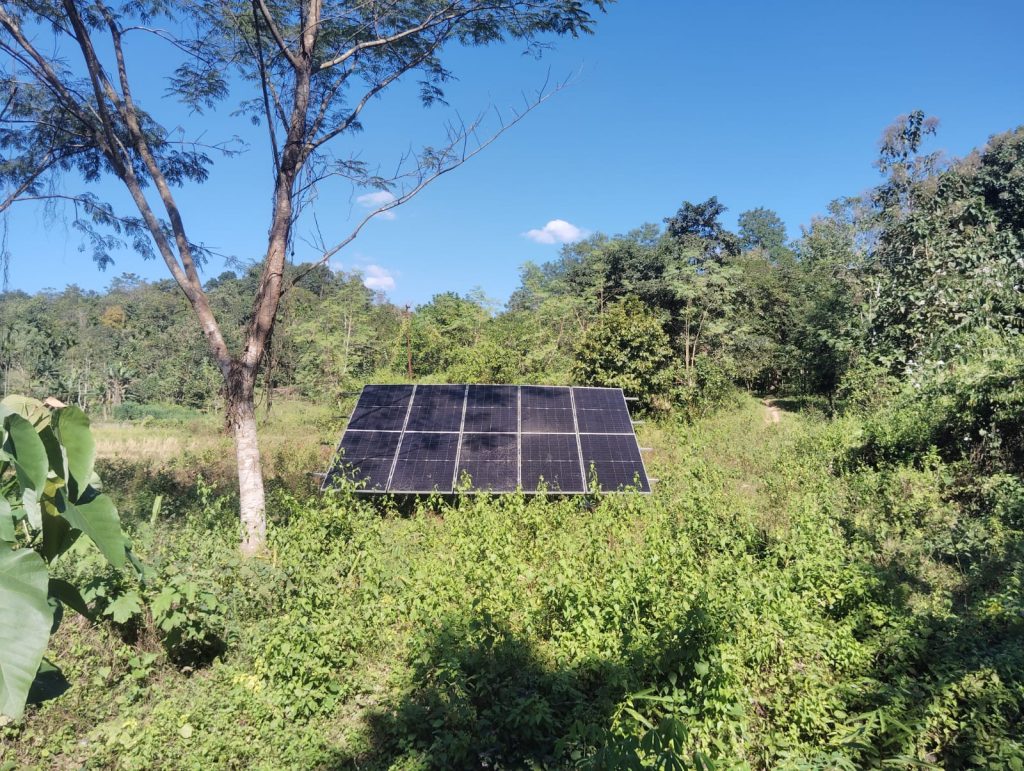
What is a Solar Water Pump?
A solar water pump is an electrically powered pump system that uses energy from photovoltaic (PV) solar panels to operate. Instead of relying on grid electricity, diesel, or petrol, it converts sunlight directly into electricity to pump water from various sources like borewells, open wells, ponds, and canals.
How Does a Solar Water Pump System Work?
The system consists of four main components:
Solar Photovoltaic (PV) Array: This is a set of multiple solar panels connected together to generate sufficient power to run the pump. The size of the array depends on the pump’s power requirement (HP) and the amount of sunlight available.
Motor Pump Set: This is the unit that does the actual pumping. There are two main types:
Surface Pump: Placed near the water source, ideal for moving water from ponds, canals, or shallow wells.
Submersible Pump: Placed underwater, inside the well or borewell, used for extracting water from greater depths.
Controller / Inverter: This is the “brain” of the system. It performs several critical functions:
Matches Power: It converts the DC power from the panels to AC power (if using an AC motor).
Protects the Motor: It regulates voltage and frequency to prevent the motor from burning out due to fluctuating solar power (e.g., on cloudy days).
Maximizes Efficiency: Many controllers have Maximum Power Point Tracking (MPPT) technology, which constantly optimizes the power flow from the panels to the pump.
Support Structure & Piping: The structure holds the solar panels at the optimal tilt angle to capture maximum sunlight. Piping is used to transport the water to the desired location (storage tank, field, etc.).
The Working Principle: Sunlight hits the solar panels, which generate Direct Current (DC) electricity. This electricity is sent to the controller. The controller then powers the motor, which drives the pump to lift and push water through the pipes.
Pros and Cons of Solar Water Pumps
Advantages (Pros)
Zero Fuel Cost: Runs entirely on free and abundant solar energy, eliminating recurring costs for diesel, electricity, or petrol.
Environmentally Friendly: Produces no greenhouse gas emissions, noise pollution, or risk of soil contamination from fuel spills.
Low Operating & Maintenance Cost: With no moving parts except in the pump, solar panels require minimal maintenance. The primary maintenance is occasional cleaning of panels and basic pump servicing.
Ideal for Remote Areas: A perfect solution for farms and villages that are not connected to the electricity grid or have an unreliable power supply.
Long Lifespan: Solar panels typically have a lifespan of 25 years, and the entire system is durable with minimal wear and tear.
Government Subsidies: Heavily subsidized by both central and state governments in India, making them highly affordable (detailed below).
Disadvantages (Cons)
High Initial Investment: The upfront cost of purchasing and installing a solar pump is significantly higher than a conventional diesel or grid-connected pump, even with subsidies.
Intermittent Power Source: The pump only operates during daylight hours. Its efficiency drops on cloudy, rainy, or foggy days. It does not work at night.
Requires Water Storage: To ensure a 24/7 water supply, a storage tank or reservoir is necessary to store water pumped during the day.
Dependent on Sunlight: Performance is directly tied to solar irradiance, which varies with geography, season, and weather.
Space Requirement: The solar panel array requires a significant amount of shadow-free land/roof space.
Indian Government Initiatives for Solar Pumps
The Government of India has been aggressively promoting solar water pumps, primarily through the Ministry of New and Renewable Energy (MNRE), to reduce the dependency on conventional energy in agriculture, curb diesel subsidies, and improve farmers’ income.
The key scheme is the PM-KUSUM (Pradhan Mantri Kisan Urja Suraksha evam Utthaan Mahabhiyan) Scheme, launched in 2019.
Components of PM-KUSUM Relevant to Solar Pumps:
Component B: This is the most direct and popular component for individual farmers. It aims to solarize existing grid-connected agriculture pumps.
Objective: To replace diesel and grid-electricity powered agricultural pumps with solar pumps.
How it Works: Under this component, individual farmers are supported to install standalone solar agriculture pumps.
Subsidy Pattern: The central and state governments provide a combined subsidy, significantly reducing the cost for the farmer. The general pattern is:
Central Financial Assistance (CFA): 30% of the benchmark cost.
State Government Subsidy: 30% of the benchmark cost.
Farmer’s Contribution: Only 40% of the cost.
Bank Finance: In many states, the farmer’s 40% share can also be arranged through low-interest loans, reducing the initial burden to nearly zero
Component C: This component is for solarizing grid-connected pumps. The farmer’s pump is connected to a solar plant, and the excess solar power generated, which is not used for pumping, can be sold to the DISCOM (power distribution company) at a pre-fixed tariff, providing an additional income stream for the farmer.
Other Key Features of the Initiative:
Customized Solutions: Pumps are available in various capacities (1 HP to 10 HP) to suit different depths and water requirements.
State Nodal Agencies: Implementation is done through state-level agencies (like KREDL in Karnataka, MEDA in Maharashtra, etc.), which release tenders and empanel vendors.
Direct Benefit Transfer (DBT): Subsidies are often transferred directly to the farmer’s bank account after installation and verification.
Focus on Off-grid Areas: Priority is often given to farmers in remote, off-grid areas where electricity supply is poor or non-existent.
Conclusion
Solar water pumps represent a sustainable and economically viable long-term solution for irrigation and drinking water needs in a sun-rich country like India. While the high initial cost and dependence on sunlight are challenges, the massive reduction in operating costs, minimal maintenance, and substantial government subsidies under schemes like PM-KUSUM make them an increasingly attractive investment for Indian farmers. They are a key tool in achieving India’s energy security and climate goals while empowering the agricultural community.